Tuskegee Study v 2.0
Passing laws that restrict access to abortion EQUALS withholding necessary healthcare from people, the same as withholding penicillin from people with syphilis.

Let’s cure a pound of patriarchy, shall we?
In case you are unfamiliar, the Tuskegee Syphilis Study was one of the most grotesque and inhumane atrocities of human experimentation in our modern history. Starting in 1932 and not stopping until the 1970’s, 600 Black men in Alabama, some with a syphilis infection and some without infection, were enrolled in a study to be observed. The researchers were observing syphilis progression in the men with infection while comparing them to the men without syphilis infection. These men were “enrolled” WITHOUT their knowledge, WITHOUT their consent, and all the while WITHOUT being treated for, or INFORMED OF, the syphilis infection. This “study” continued for decades, and the only reason it stopped was thanks to a whistleblower and the resulting public outrage became too much for the US government to withstand. Think about that. Please understand that syphilis is a sexually transmitted infection that can cause death, neurologic morbidity, and serious harm to fetuses in pregnant people, and there is a treatment for it: penicillin. This antibiotic was known to be highly effective against syphilis and became the standard for treatment in the 1940’s. Two thirds of these men had syphilis infections and were placed in the “experiment” category, while 1/3 of the men had no infection and were followed as the “control” group. The experiment was to not inform the men of their syphilis infection and deny them treatment so the government could observe the long-term effects of the infection. The United States Public Health Service (USPHS), a subset of the Department of Health and Human Services, ran this racist death camp of human experimentation. These men were not told they had syphilis. They were not counseled that they could pass it on to sexual partners. They were not cautioned that syphilis passed on to a pregnant person could irreparably harm the fetus/newborn. Why would these men agree to be in a government program treating them for “bad blood?” Because they were enticed with free healthcare (otherwise difficult for Black people with little money in the rural South to access during The Great Depression), meals, transportation and burial insurance. Yes, that is correct: burial insurance. So when penicillin became widely available and well-known as the standard of care to treat syphilis, these government officials not only withheld penicillin from their patients in their own sphere, but they also exerted significant efforts to PREVENT these men from receiving treatment elsewhere. The USPHS coordinated with other local physicians and military draft boards to deny these men treatment so as to not “ruin the experiment.” They went to great lengths not only to withhold the treatment but also to WITHHOLD ACCESS to treatment. This continued for 25 YEARS after penicillin was the gold standard. [1-4]
The rampant systemic racism in medicine clearly played a large part in how this ever came to be in the first place, of course. Bigoted ideas such as Black people don’t feel as much pain as white people, or Black men are stronger and therefore “won’t get as sick” as white people are just a few brief examples. But human experimentation on Black people was not something new in this country in the 1930’s… No. We have a long, sordid history of torturing Black, Brown and Indigenous peoples under the guise of “gaining medical knowledge” that was all too common with enslaved people in the 18th and 19th centuries [5,6]. The United States just celebrated (I wasn’t celebrating) its 250th birthday and for 198 of those years these “acceptable methods” of human experimentation went unchecked and unregulated. In 1974 the National Research Act was implemented and served to protect people from harm in scientific studies, including establishing Institutional Review Boards (IRBs). Keep in mind the US and the world had already seen the atrocities of Nazi human experimentation and the Nuremberg Code had been in existence for almost 30 years by the time the National Research Act came to be. It wasn’t as though medical researchers in Tuskegee “just didn’t know” what medical ethics were, or what racism was, or, frankly, that what they were doing was blatantly wrong. Of course this is speculation on my part, but I have seen what racism in medicine looks like and I am not convinced of any lack of self-awareness possessed by the people in a position of power (the white government researcher, in this example) and how that guides their behaviors: “They’re just 600 poor Black men in rural Alabama. They don’t really matter and what we’re doing will benefit all of humanity, so it’s ok.” To be clear: no one benefited from this “research.” Men went blind, suffered cardiovascular and neurologic long-term health problems, passed the infection to their partners, and if their partners were pregnant at the time then it was passed on to their newborns. Approximately 128 of these men died from syphilis and its complications. Forty partners reported being infected and 19 children were born with congenital syphilis. “But they were all Black…and poor…so it was ok...” The researchers would contend that knowing how the disease progressed contributed to knowledge of the disease, but here’s my thing: there was no treatment for this infection for millennia prior to penicillin, so we already knew what disease progression looked like. All we would need to do is look up documented observations of the previous *shuffles through notes* thousand years or so. I, personally, cannot see any way to justify this denial of care leading to severe morbidity and mortality of not only the men forced to be “research subjects” but also of their loved ones. Imagine the ripple effect of 400 people with a deadly, transmittable condition that was intentionally left untreated. Unconscionable.
The terrifying reality is we seemingly haven’t learned from Tuskegee or Sims or Mengele because even today, in the 21st century with all of the protections of the National Research Act and the IRBs and ethics boards etc., we are still experimenting with human lives and withholding known treatments from people. The difference this time is: there is no declared experiment, nor is there any semblance of a pretense of “benefit to all of humanity.” It’s simply a thing we are doing because the Supreme Court of The United States (SCOTUS) said we could and people are dying as a result. We are withholding the known treatment of the life-threatening condition known as pregnancy. The United States has the highest maternal mortality rate among high-income nations on the planet. Pregnant people are 2-6 times more likely to die in pregnancy and birth in our country than in Canada, Australia or European nations [7-9]. Pregnant people who do not wish to risk their health or their lives in pregnancy or birth have one available treatment plan: abortion. Abortion is the ONLY healthcare option for people who are pregnant and don’t want to be pregnant. So when SCOTUS says that individual states can decide for themselves whether pregnant people living in those states are allowed access to this healthcare, what else can you call it but a menacingly unethical experiment with human lives? After all, there is no factual basis or ethical reasoning to make this aspect of healthcare illegal. More importantly, it is clearly unethical to force people to remain pregnant and give birth. We are forcing people to risk their health and lives, how is that ethical? The men in Tuskegee were proactively kept ignorant of their condition and diagnosis, but pregnant people absolutely know what their condition and diagnosis are. With the Dobbs decision, SCOTUS declared pregnant people's autonomy as superseded by government authority, just as we saw the government declare itself the authority over the autonomy of Tuskegee men in the 1930s. Whether it’s a medication like penicillin or mifepristone, or a medical procedure, how is withholding healthcare ethical? Do ethics come into question ONLY if there is “research” involved, such as submitting a proposal, submitting grant applications, obtaining IRB approval, etc? I have conducted clinical research on human subjects so I know first-hand the intense scrutiny involved in such an endeavor, but it strikes me as nothing short of insanity that as long as it’s “not research” then we need not worry about the ethics of withholding healthcare from human beings. Is that REALLY what we learned from Nuremberg and Tuskegee? Just because something doesn’t involve research doesn’t mean it’s not an experiment. We accept the Supreme Court, having no training or education in healthcare provision, as having the power to perform a healthcare experiment on the American population WITHOUT ethical oversight? Yes, that’s what it is to place different rules on different people arbitrarily based on zip code: an experiment. In this context, the experiment consists of two groups: some people can have needed healthcare while others cannot have needed healthcare. Depending on the model of approach, this experiment could be considered a case-control study or a randomized controlled trial, but I think a randomized controlled trial is more applicable here. In a study approved by an IRB, each person who has 1) agreed to participate in the study and 2) signed informed consent would then be placed at random into one of the two aforementioned groups. Each person would then be followed and/or assessed over time regarding the predetermined study outcomes of interest. For SCOTUS, the randomization process was whichever states would or would not restrict abortion. One group is composed of the states that restrict abortion and are shown below in red. The other group is composed of the states that do no restrict abortion and are shown below in blue. In this human experiment, however, no one is allowed to not participate, no one is allowed to leave the experiment and no one is being offered, let alone signing, informed consent.
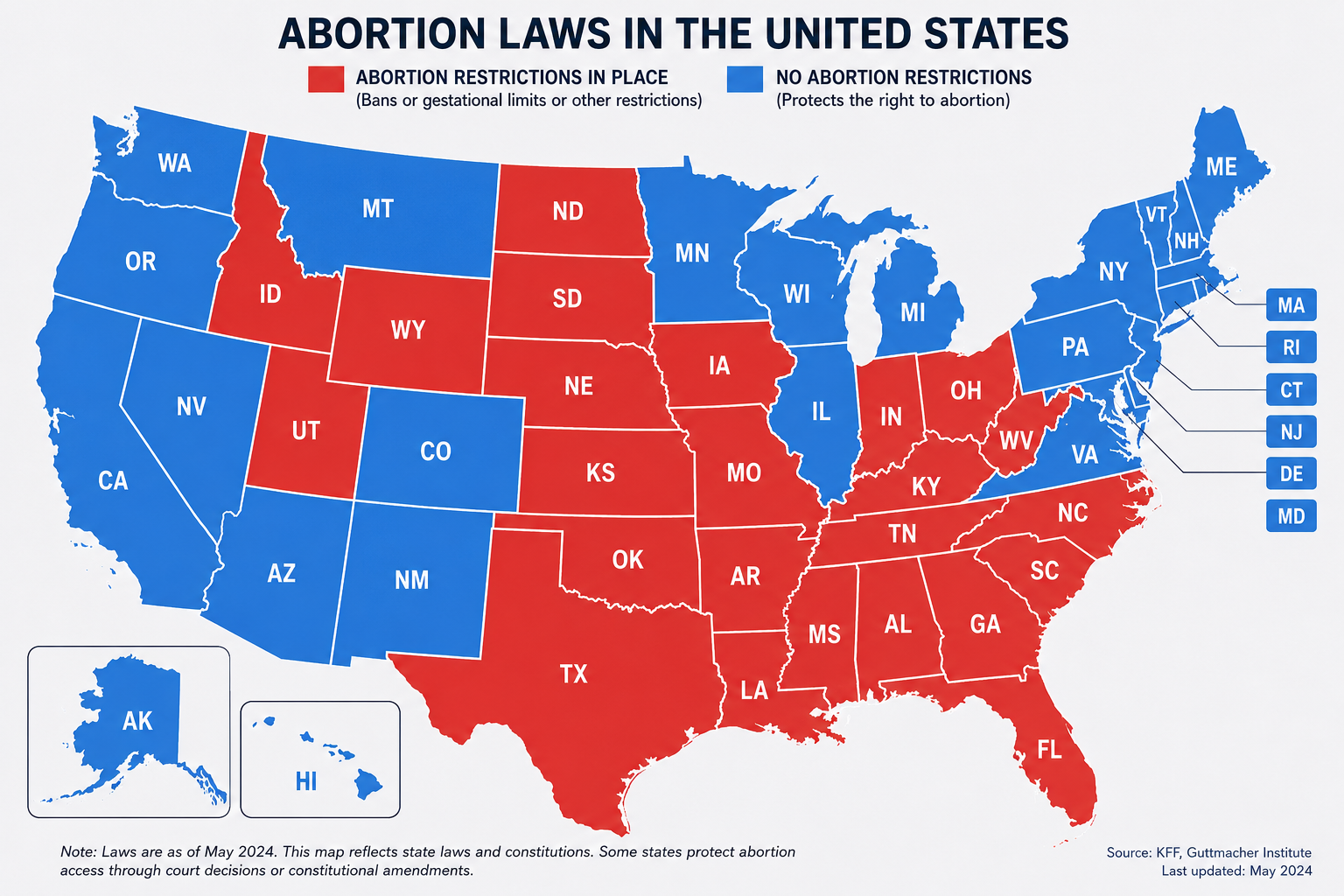
Fact: human physiology does not change with zip code. Because human physiology does not change with zip code, how healthcare is provided does not change with zip code. Imagine that people in Washington are allowed to have colon cancer screening but people in Maine cannot because colonoscopies are illegal. Abortion is as much healthcare as any cancer screening or treatment of an undesired condition. (Can’t imagine a colonoscopy being illegal? Consider the Puritanical values that inform our current regulations and get back to me.) So it is precisely BECAUSE human physiology has nothing to do with geography that Dobbs is, at best, an experiment. At worst, and I think most accurately, Dobbs is a grotesque violation of the Universal Declaration of Human Rights. Healthcare bans and restrictions are nothing short of unethical and what would absolutely be considered illegal human experimentation. There is very little difference between what SCOTUS did with Dobbs and what the USPHS did in Tuskegee, although one aspect of how they differ is the magnitude of their effects. They both withhold necessary medical treatment from people who need it, they both adversely affect Black, Brown, Indigenous and other people of color (BIPOC) to a greater extent than white people, neither of them obtain informed consent from the people affected, and both have directly caused people’s deaths.
Dobbs would undoubtedly be illegal if it were clinical research. That Dobbs is a “SCOTUS decision” and not a “clinical trial” is a pathetic and cowardly technicality hiding behind the desire to inflict human torture. No Institutional Review Board would EVER allow such an experiment to take place due to the unethical practice of withholding needed medical treatment. Here are the ways the Dobbs decision violates the ethics of clinical research practice:
1. It violates the principle of clinical equipoise
Clinical equipoise means there must be genuine uncertainty within the expert medical community about which intervention is better.
If investigators already know that:
· one group needs an abortion because it is medically indicated,
· and denial is expected to increase the risk of morbidity or mortality,
then there is no uncertainty. Researchers would knowingly be assigning participants to an inferior or harmful condition.
Without equipoise, an RCT is considered unethical.
2. It violates beneficence and nonmaleficence
The Belmont Report identifies beneficence as a core ethical principle:
· maximize benefits
· minimize harms
Randomly denying necessary medical care intentionally exposes participants to foreseeable harms such as:
· hemorrhage
· infection
· progression of pregnancy complications
· increased maternal morbidity
· potential mortality
· psychological distress
· financial hardship
Because these harms are foreseeable rather than accidental, an IRB would view the study as creating unjustifiable risk.
3. Risks would outweigh any potential scientific benefit
Federal regulations governing human subjects research (the Common Rule, 45 CFR 46) require that:
Risks to subjects are reasonable in relation to anticipated benefits and the importance of the knowledge expected to result.
An IRB would likely conclude:
· participants receive little or no direct benefit from randomization,
· risks are substantial,
· the same research question can be studied using observational methods.
Therefore the risk-benefit ratio fails.
4. It intentionally withholds accepted medical care
Research ethics generally prohibit withholding established effective treatment solely for research purposes.
Examples include:
· withholding insulin from diabetics
· withholding antibiotics for bacterial meningitis
· withholding blood transfusions for hemorrhage
· withholding indicated surgery for appendicitis
Abortion is medically indicated for a participant when a participant is pregnant and does not want to continue being pregnant, thus random assignment to denial would similarly mean withholding indicated care.
5. Informed consent does not make harmful research ethical
A common misconception is that informed consent alone makes a study ethical.
It does not.
Participants cannot simply "consent away" unethical study design.
IRBs routinely reject studies even when volunteers are willing to participate if:
· risks are excessive,
· benefits are inadequate,
· investigators intentionally create preventable harm.
In our example, there is not even the pretend existence of informed consent in withholding abortion care.
6. Justice would be violated
The Belmont principle of justice requires that:
· burdens of research are distributed fairly,
· participants are not exploited.
Randomizing individuals into denial of medically indicated care imposes unequal burdens that exist solely because of the study.
7. The Declaration of Helsinki would prohibit it
The World Medical Association's Declaration of Helsinki states that:
· the well-being of research participants must take precedence over the interests of science,
· new interventions should generally be tested against the best proven intervention,
· patients should not be exposed to unnecessary risks.
Deliberately denying necessary care would conflict with these principles.
We are in the midst of a grotesque Tuskegee-esque Study on pregnant people. A vulnerable population is once again subjected to the human experimentation whims of the US government. Once again, Black, Brown, Indigenous, non-white people are affected disproportionately more: not only regarding how many people but also how severely they are affected. Before Dobbs happened, the maternal mortality rate of BIPOC was 3 times that of white counterparts. That is already an abysmal fact and it has not improved since 2022. Now add withholding needed healthcare and that rate either doesn’t change or increases. Either way, a racist outcome ensues. People suffer and people die preventable deaths. This includes the preventable deaths of newborn babies. Black infants are dying at higher rates post-Dobbs and there was an overall increase of all infant deaths after banning abortion was allowed. The increased rate of babies dying was pronounced in states that banned abortion, especially in the South [10]. Clearly “protecting children,” “saving babies” and protecting “the domestic supply of infants” are not the goals of Dobbs. They’re certainly not the end results.
It does NOT matter if it’s called “a Supreme Court decision,” “a clinical trial,” “the rules of engagement,” “the ten commandments,” or whatever overarching theme is invoked: withholding medical treatment from people is inhumane and illegal. Passing laws that restrict access to abortion EQUALS withholding necessary healthcare from people, the same as withholding penicillin from people with syphilis. Maybe this is a call to the United Nations to sanction the United States for crimes against humanity and violating the Universal Declaration of Human Rights, the Nuremberg Code, the Declaration of Helsinki, the Belmont Report, etc. Maybe this is a call to every voter in the country to make sure they vote for candidates who oppose human torture and unethical human experimentation. Maybe this is a call to work together to protect pregnant people and ensure they get the healthcare they need, regardless if its abortion care, prenatal care, postpartum care, etc. All I know is, watching another Tuskegee Study unfold is beyond reprehensible and we must stop it.
The Tuskegee Study has become "a powerful metaphor that symbolizes racism in medicine, misconduct in human research, the arrogance of physicians, and government abuse of Black people." -Vanessa Northington Gamble [11,12]
Citations:
1. Jones, J. H. (1993). Bad blood: The Tuskegee syphilis experiment (Rev. and expanded ed.). Free Press.
2. Washington, H. A. (2007). Medical apartheid: The dark history of medical experimentation on Black Americans from colonial times to the present. Doubleday.
3. Villarosa, L. (2022). Under the skin: The hidden toll of racism on American lives and on the health of our nation. Doubleday.
4. Reverby, S. M. (Ed.). (2009). Examining Tuskegee: The infamous syphilis study and its legacy. The University of North Carolina Press.
5. Cooper Owens, D. B. (2017). Medical bondage: Race, gender, and the origins of American gynecology. The University of Georgia Press.
6. Roberts, D. (1997). Killing the Black Body: Race, reproduction, and the meaning of liberty. Pantheon Books.
7. Centers for Disease Control and Prevention, National Center for Health Statistics. (2026). Maternal mortality rates in the United States, 2024. https://www.cdc.gov/nchs/data/hestat/hestat113.htm
8. Organisation for Economic Co-operation and Development. (2023). Health at a glance 2023: OECD indicators. OECD Publishing. https://www.oecd.org/en/publications/health-at-a-glance-2023_7a7afb35-en.html
9. World Health Organization, United Nations Children's Fund, United Nations Population Fund, World Bank Group, & United Nations Department of Economic and Social Affairs, Population Division. (2023). Trends in maternal mortality 2000 to 2020: Estimates by WHO, UNICEF, UNFPA, World Bank Group and UNDESA/Population Division. World Health Organization.
10. Gemmill, A., Franks, A. M., Anjur-Dietrich, S., Ozinsky, C., Arbour, D., Stuart, E. A., Ben-Michael, E., Feller, A., & Bell, S. O. (2025). US abortion bans and infant mortality. JAMA, 333(15), 1315–1323. https://jamanetwork.com/journals/jama/fullarticle/2830298
- Gamble, V. N. (1997). The Tuskegee Syphilis Study and women's health. Journal of the American Medical Women's Association, 52(4), 195–196. https://pubmed.ncbi.nlm.nih.gov/9354052/
- Gamble, V. N. (1997). Under the shadow of Tuskegee: African Americans and health care. American Journal of Public Health, 87(11), 1773–1778. https://ajph.aphapublications.org/doi/abs/10.2105/AJPH.87.11.1773