Autonomy is Freedom

Let’s cure a pound of patriarchy, shall we?
Autonomy: n. having the freedom and authority to govern or direct oneself—either personally (making your own decisions without being controlled by others) or politically/organizationally (the right of a region, country, or organization to govern itself). [1-3]
Autonomy is the concept of self-ownership and is one of the principle medical ethics along with justice, beneficence and nonmaleficence. Respecting someone’s autonomy is at the very core of healthcare provision. It is a critical part of guiding medical decision making and obtaining informed consent. For the benefit of this discussion, I do not refer to infants, people in comas or to those who might otherwise not be able to make decisions for themselves—here we presume capacity for autonomy. I want to explain what happens when autonomy is revoked from people like you and me, and let me be very clear: if autonomy can be revoked from someone, it can be revoked from anyone.
The revocation of autonomy is a principle upon which the foundation of our nation was built. We must acknowledge the inhumane and devastating circumstances under which the United States of America came into existence. Some five hundred years ago* European colonizers landed on the continents of the Western Hemisphere and massacred indigenous peoples who have lived here for tens of thousands of years [4]. Those who were not murdered were displaced from their homes and subjugated to conform to European language, culture and way of life. To put it so mildly as to be offensive (which is not my intention): the autonomy of indigenous peoples had been revoked. Half a century before Columbus, the enslavement of African peoples was first perpetrated by the Portuguese and then spread to various European nations engaging in the transatlantic slave trade, kidnapping Africans and taking them to the Americas. The voyages across the Atlantic alone killed upwards of 2 million people (a number that could very well be and underestimation). Although the term “genocide” would not appear in world history until the mid-20th century, it applies to the enslavement of Africans and the subjugation of indigenous peoples.
Genocide: n. the intentional destruction, in whole or in part, of a national, ethnic, racial, or religious group. This destruction can occur through killing members of the group, causing serious bodily or mental harm, deliberately inflicting conditions of life calculated to bring about the group’s physical destruction, imposing measures intended to prevent births, or forcibly transferring children of the group to another group. [5,6]
The legalized revocation of autonomy from and imposition of second-class citizenship on non-white and/or non-cis-het-male people has taken many forms over the centuries and continues today. From colonization and enslavement to Jim Crow racism, the eugenics movement in the US and the Third Reich in Germany, and into present day U.S. Immigration and Customs Enforcement (ICE) raids and outlawed health care. As I am not an historian nor any kind of scholar in these areas, I am merely trying to demonstrate the repeating pattern of the patriarchy that we must work to break. I am not equating any of these world history events, but rather showing that it isn’t just in our nation’s history nor is it simply something of the very distant past. The “other”ing of groups of people, the physical removal of people from their homes/way of life to be placed in custody of the state, the persecution of simply existing—what we are seeing in the United States today is a different chapter of the same story and we must not ignore it. I asked the Internet for help in seeing repeating patterns so I ask you to look at this table and consider it in today’s context of current events:
Comparative Mechanisms of Subjugation: Indigenous Peoples in the Americas and Victims of Nazi Germany [7-12]**
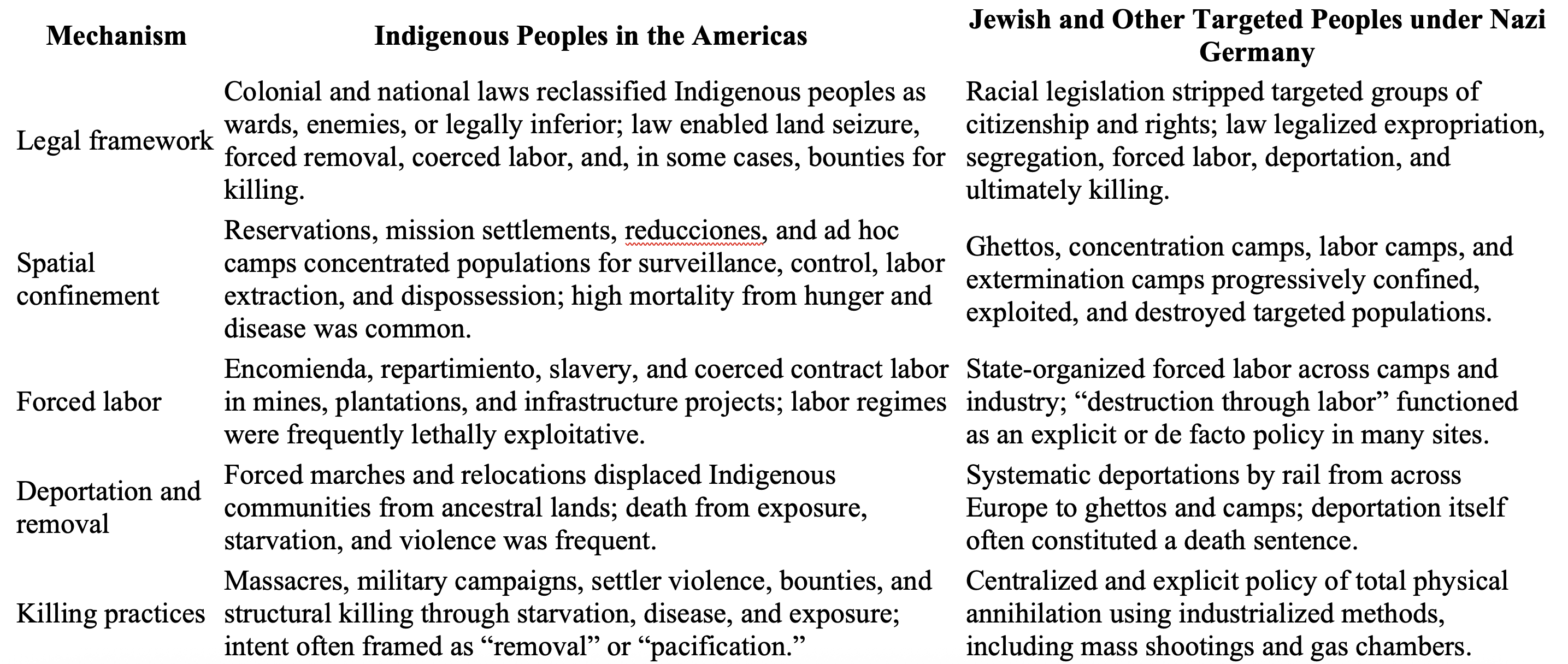
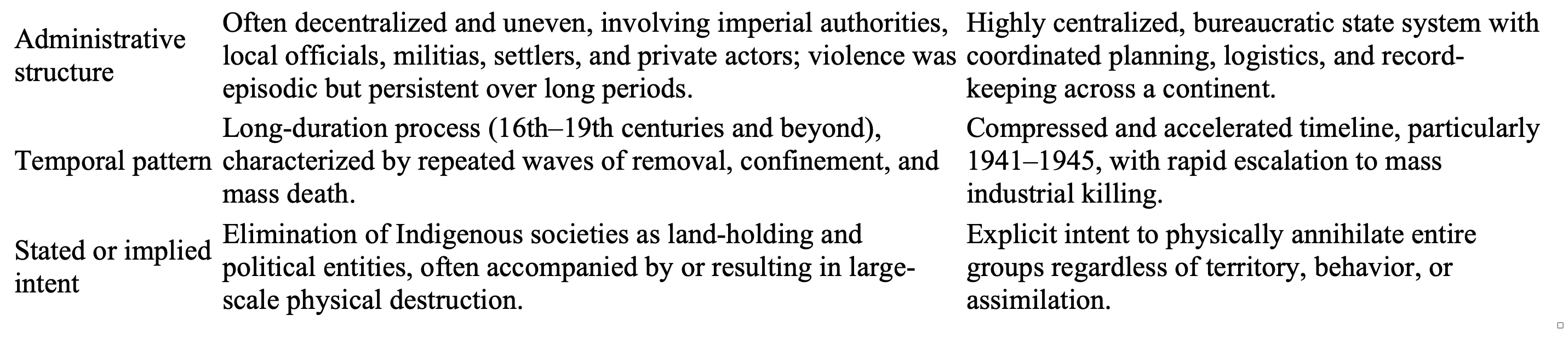
Many other historical events fit these parameters as well, make no mistake. The table could be much wider with other subjugated peoples, but the idea is to make clear the repeating patterns so that we may work to break the cycle. We are in the middle of the continued subjugation of entire groups of people and it is getting worse. Consider that the Jim Crow South was the patriarchy’s answer to at least the 13th, 14th and 15th Amendments of the Constitution. We are witnesses that the government-sanctioned kidnapping*** and murder of Black and Brown people continues today and has paved the way for ICE murders and kidnapping. The Dobbs decision ignores the 4th, 5th, 8th-10th, 13th and 14th Amendments and permits the State to have ownership of pregnant people. History shows clearly that the states most insistent on enforcing the Jim Crow era of oppression were the same states that fought a war to protect their “right” to own other people and are presently the same states asserting their ownership of pregnant people. Without bodily autonomy there cannot be freedom. Abolitionists knew this and it is to them we owe our present day understanding of bodily autonomy as the core of freedom itself. Control over one’s body is where freedom begins. Studying the abolitionist Frederick Douglass [13,14], for example, one learns that bodily autonomy is the precursor to all other basic human rights:
· The body must not be owned (this does not change with pregnancy)
· Labor must not be coerced (including the labor of gestating and birthing)
· Movement must not be restricted (across state lines or otherwise)
I hope it is clear by now that this was never the land of the free, at least not for anyone who wasn’t a land-owning white man. The Constitution, like any law or regulation, doesn’t mean anything if the rights outlined therein are only protected for some, or laws are only enforced in some cases. As far as I’m concerned, the Constitution is a decoration in a museum at this point. We can and must do better. There are several developed nations with constitutions that not only protect fundamental human rights but also enforce and uphold these rights in independent courts with limited arbitrary government power. (Wouldn’t that be nice?)
Autonomy is a principle ethic in providing healthcare, and access to healthcare is a fundamental human right according to Article 25 of the United Nations Universal Declaration of Human Rights:
- Everyone has the right to a standard of living adequate for the health and well-being of himself and of his family, including food, clothing, housing and medical care and necessary social services, and the right to security in the event of unemployment, sickness, disability, widowhood, old age or other lack of livelihood in circumstances beyond his control.
- Motherhood and childhood are entitled to special care and assistance. All children, whether born in or out of wedlock, shall enjoy the same social protection.
Several of our laws, regulations and SCOTUS decisions violate this and other articles of the Universal Declaration of Human Rights. Perhaps it’s time for the United States of America to do a page one rewrite of our constitution. Then, we actually uphold it from the lowest court to the highest. Revocation of autonomy should be against the law, not the law of the land. If someone is criminalized for making decisions regarding their own body, they do not have autonomy and thus they are not free. As Fannie Lou Hamer said: “Nobody’s free until everybody’s free.”
For the master’s tools will never dismantle the master’s house. They may allow us to temporarily beat him at his own game, but they will never enable us to bring about genuine change.
– Audre Lorde
Citations:
1. Cambridge University Press. (n.d.). Autonomy. In Cambridge Dictionary. https://dictionary.cambridge.org/us/dictionary/english/autonomy
2. Merriam-Webster. (n.d.). Autonomy. In Merriam-Webster.com dictionary. https://www.merriam-webster.com/dictionary/autonomy
3. Oxford University Press. (n.d.). Autonomy. In Oxford Learner’s Dictionaries. https://www.oxfordlearnersdictionaries.com/us/definition/american_english/autonomy
4. World History Encyclopedia. (2020). European Colonization of the Americas. https://www.worldhistory.org/European_Colonization_of_the_Americas/
5. Lemkin, R. (1944). Axis rule in occupied Europe: Laws of occupation, analysis of government, proposals for redress. Carnegie Endowment for International Peace.
6. United Nations. (1948). Convention on the Prevention and Punishment of the Crime of Genocide. https://www.un.org/en/genocideprevention/documents/atrocity-crimes/Doc.1_Convention on the Prevention and Punishment of the Crime of Genocide.pdf
7. Kiernan, B. (2007). Blood and soil: A world history of genocide and extermination from Sparta to Darfur. Yale University Press.
8. Madley, B. (2016). An American genocide: The United States and the California Indian catastrophe, 1846–1873. Yale University Press.
9. Moses, A. D. (Ed.). (2010). Empire, colony, genocide: Conquest, occupation, and subaltern resistance in world history. Berghahn Books.
10. Stannard, D. E. (1992). American Holocaust: The conquest of the New World. Oxford University Press.
11. Wolfe, P. (2006). Settler colonialism and the elimination of the native. Journal of Genocide Research, 8(4), 387–409. https://doi.org/10.1080/14623520601056240
12. Zimmerer, J. (2011). Colonial genocide and the Holocaust: Towards an archaeology of genocide. In A. D. Moses (Ed.), Empire, colony, genocide (pp. 323–344). Berghahn Books.
13. Douglass, F. (1845). Narrative of the life of Frederick Douglass, an American slave, written by himself. Boston, MA: Anti-Slavery Office.
14. Douglass, F. (1855). My bondage and my freedom. New York, NY: Miller, Orton & Mulligan.
15. Rehavi, M. M., & Starr, S. B. (2014). Racial Disparity in Federal Criminal Sentences. Journal of Political Economy, 122(6), 1320–1354. https://doi.org/10.1086/677255
16. Steffensmeier, D., Ulmer, J. T., & Kramer, J. H. (1998). The Interaction of Race, Gender, and Age in Criminal Sentencing: The Punishment Cost of Being Young, Black, and Male. Criminology, 36(4), 763–798.
*Norse settlements appeared first at least 500 years before Columbus, however those settlements were seemingly not permanent. I could not find evidence of invasion of indigenous peoples by the Norse explorers but this is not my area of expertise, of course.
**Please understand that I recognize only the Holocaust can be compared to the Holocaust. This table presents an empirical comparison of mechanisms used to subjugate and destroy populations, as analyzed in comparative genocide and settler-colonial scholarship. It is analytical rather than moral and does not imply historical equivalence; scholars emphasize differences in scale, speed, centralization, and technological implementation, particularly in the case of Nazi Germany.
***What is wrongful imprisonment, or statistically significant lengthier sentences, of Black and Brown people compared to white people if not kidnapping? [15, 16]